11/08/2015

Special Relativity: Energy and Mass

Who hasn’t heard the equation E=mc2? Very, very few people. If you know only one scientific equation that would be it. We know that Einstein came up with the equation and that it stems from the theory of special relativity but many of us do not know what it really means or why it is important. Well, today we are going to learn together.

It again goes back to the photon which has no mass but has momentum. This is strange since momentum is all about velocity and mass. How then can a photon exhibit momentum? The answer according to Einstein was to equate the energy that makes up the photon to a specific quantity of mass.  The way that Einstein proved this idea was to think of a stationary box placed in the middle of space, a photon is inside the box which due to its obvious momentum travels from side to side, the momentum needs to be conserved so the box must also begin to move. If the photon hits the side of the box, the momentum is then transferred to the box and voila the box again is made stationary. The one thing that we need to note is that there are NO external forces acting upon our box and photon combo so therefore the centre of mass must remain in the same spot the entire time (even when the box moves). The only way to make sense of the immobile centre of mass is to give the photon’s energy some sort of mass equivalence.

Alright, now let’s look at the math. (c= speed of light, v=velocity, M=mass box, Δt = change in time, Δx= distance moved, E=energy or the photon, L=length of box, m= mass of photon)

M(Δx/Δt) = E/c

Since the momentum of the photon is the speed of light and the momentum of the box is its mass multiplied by the velocity and we know the momentum is conserved we can make this general equation.

Next, if we say that the change in time equals the length of the box divided by the speed of light then with some rearrangement and applying the idea that the photon has mass (so we can calculate the centre of mass of our system), we can end up with this little equation: (since the centre of mass is the same at the start and end of the experiment).

mL = MΔx

Finishing our math with some substitution which will magically give us E=mc2 
(If you want all the steps you can find them on this website: http://www.adamauton.com/warp/emc2.html)

Let’s look more carefully at this equation; it proves that energy and mass essentially can be used to measure the same thing. By this I mean that Einstein basically said mass was simply another form of energy – mind you it is very, very, very concentrated energy. So, how does this relate to nuclear energy? Well fission is the process by which neutrons are shot towards the nuclei of atoms, this splits the atoms releasing energy and neutrons. At the end of the process if we were to actually calculate the mass of the product it would be just a little bit less than the mass of the reactants – this means that the mass went somewhere and Einstein proposed that it went to energy. If the quantity of mass that is missing is so small why do we get such large energy releases from nuclear bombs/power plants? this again can be referred back to the equation E-mc2 ; since the speed of light is so very large and then we take that number and square it; the result is A LOT of energy produced. Think of it this way for every kilogram of mass the impact can be equated to more than 40 megatons of TNT! That is a lot of energy. Take your weight in kilograms, if we could harvest  all the energy inside you; you could power millions if not billions of homes. However, if we were to try to release all the energy nuclear fission would simply not work since it only releases a small amount of the atoms mass and most of it remains in its original form of protons/neutrons/electrons. Therefore we turn to other ways of releasing energy such as using antimatter; it has the same particles as matter but opposite charges. The sad thing is that currently we need to actually use particle accelerators to produce antimatter and it would take millions of years to produce very small quantities of it.

Special relativity is a theory that states with speed comes greater mass, essentially this explains how particle accelerators work (accelerate protons to as close to the speed of light as possible and hit them together – this smashing produces particles of greater mass than protons which could be studies by scientist, Einstein’s equation being a large contributor since it would give insight into these new particle masses.)  


I know what you are waiting for - the grand atomic bomb. I have already talked about the importance of the speed of light and how the majority of the energy we see produced comes from the speed of light however we have not looked at how this explains the atomic bomb. To do this we need to give Einstein some credit since his theory made other scientists realize the atomic bombs potential; however, the equation was not meant for destruction when it was first published. The bombs were created by the process of a bunch of fission chain reactions (called meltdown reactions: when there is a consistent flow of neutrons released hitting more and more uranium atoms resulting in greater amounts of heat which melt everything surrounding the uranium). If you didn’t already grasp this the idea behind the bomb is to smash a bunch of uranium together in a short amount of time to create a fast fission process. During World War II two bombs were dropped containing the power of about 20 kilotons of TNT.

Websites Consulted:
http://www.emc2-explained.info/Emc2/Fission.htm#.VivgwPmrSUk
http://www.theironsamurai.com/2015/08/28/word-is-worse-than-the-atomic-bomb-technical-writing-nightmare-quote/


11/07/2015

Quantum vs. Classical

When we look at physics there are various theories and ideas. In this post we will look at the limits of Classical Mechanics and how Quantum Mechanics can fill in the gaps that Newtonian Mechanics (another name for Classical Mechanics) seems to have left open or unexplained.

Blackbody Radiation:

To understand this concept the first thing to know is that everything that has a temperature above absolute zero will release light – even pitch black objects (their light is created by blackbody radiation).

Classical Mechanics approached blackbody radiation by stating that light is formed by waves that are made via vibrations. The hotter the object, the more the kinetic energy, or the faster  the vibration of electrons resulting in the production of more light. This all makes perfect sense; however, the picture posted directly under the title of this section is where classical mechanics falls short. According to classical mechanics all frequencies have the same energy. This is wrong as we can see when we look at the picture of the experimentally calculated values. So, how does this make any sense? Bring in quantum mechanics! We talked about Planck’s constant so now we are going to talk about the man behind this number, Max Planck. Planck came up with a quantum (or in layman terms a group of energy), the size of any quantum is dependent on the vibrating frequency of the electrons.

His equations:  energy = Planck’s constant x frequency

The explanation: the energy of the electron can be multiplied by any integer but the electron needs to have at the minimum one quantum of energy to vibrate. Without this single quantum of energy the thing will NOT light up. Going back to the picture, the higher frequencies have too much quantum energy so the vibrations are unable to actually commence!

Hydrogen Atom:

Everybody asks about the good old hydrogen atom in grade ten chemistry since it has properties of both metals and non–metals but today we are going to go deeper into the 'simplest' little atom. Hydrogen is a diatomic gas and when it is heated it will glow (aka release light). It does not however come from blackbody radiation; it comes in red, blue/green and purple wavelengths. Hydrogen is made of one proton and one electron and the electron orbits the nucleus simply due to the attraction between the positive proton and the negative electron.


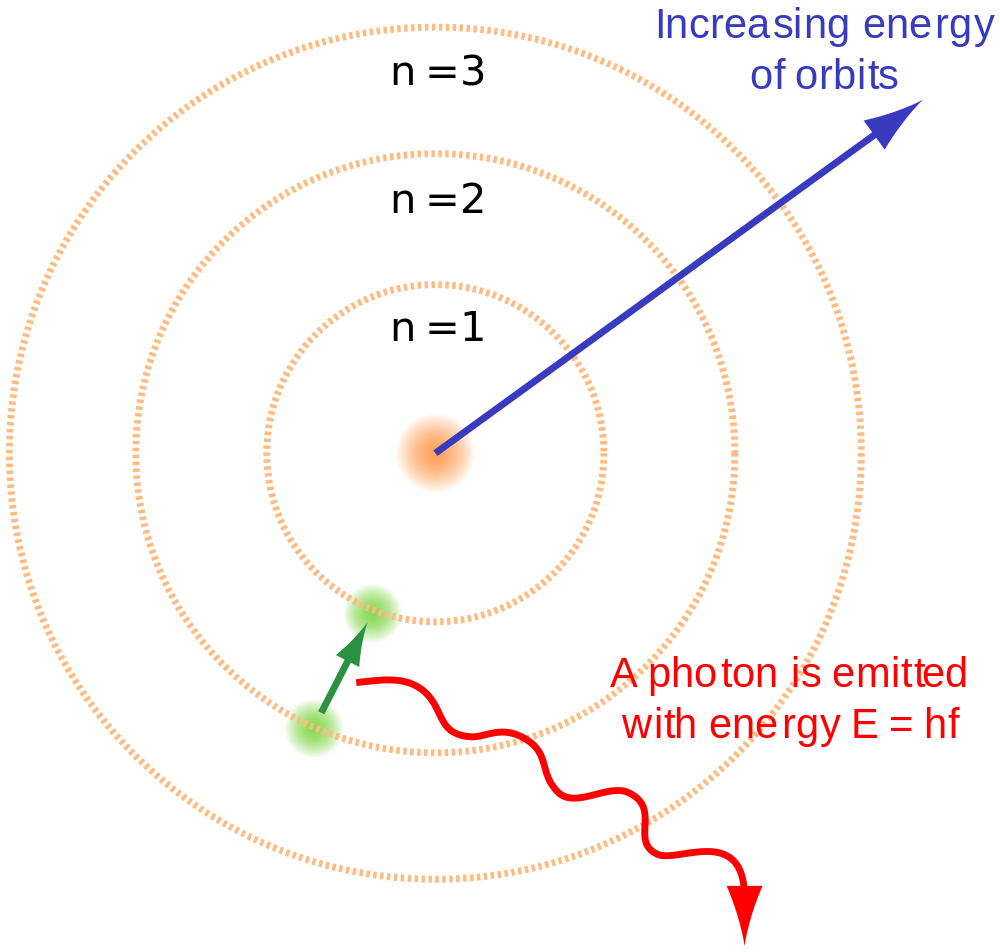
This is when the classical physicists strayed from the facts; they said that the electron is in a continual state of changing directions and this allows for the light to be emitted. The problem is that this means that the electron is always losing energy – actually losing all its energy, falling from its orbit until it is on top of the proton (this would effectively kill the atom). Of course we know this is wrong. Another scientist that was already mentioned in a previous post is Niels Bohr. Bohr came up with the factual explanation – he came up with the idea that the electron must orbit the proton at specific orbits which enables a specific radius and energy. Bohr then came up with the idea that actually saved countless hydrogen atoms (not really but he did prevent us from believing that hydrogen atoms lasted only a fragment of a second). The idea is that when the electron stays in one of its specified orbits it cannot release energy (produce light) – his explanation produced the calculations for the wavelengths of the colours described above for the Hydrogen atom.

Now, we discussed this before (in a previous post) but let’s reiterate. Bohr explains that electrons will produce light if they are able to fall from greater orbits. We said that this produces a photon with the energy that is lost when the electron falls. * This goes along with the idea of conservation of energy since the energy is never really lost just transferred to a photon.  Photons can then be used as energy sources to allow for the electrons of other atoms to jump to greater orbitals; all the photon has to do is strike the atom and bam the electron is propelled to a greater orbit – this is what is labelled a quantum jump.

Generally Speaking:
Classical:
  •         Predictable, using math and logic to solve problems. The extrapolation of something small to something on a larger scale.
  •          Matter makes up the universe – matter is made of particles
  •          Perception is limited to what a person can hear, see, smell, touch, taste – if it doesn’t fit into one of these categories it is irrelevant or simply fictional 
Quantum:
  •          Energy is the basis of everything – even us!
  •           Only energy is key - matter is simply energy 
  •         There are only possibilities and observations; when observed the possibilities dissipate and the observation becomes the reality (or more simply put observation is necessary for there to be reality)
  •          Electron orbits represent the location of electrons relative to a nucleus, there is no set path or pattern for electron movement
  •          Electrons can be in more than one place at a given time
Websites Consulted:
http://www.micromountain.com/assets/newhanim3.gif
http://resourcefullife.net/newtonian-vs-quantum-mechanics-perspectives/


10/27/2015

Quantum Mechanics: Wave-Particle Duality

Word Wall:
Quantum Mechanics: a division of mechanics that looks into the math behind the motion/relationships of subatomic particles (ex: electrons, protons, neutrons).

Quarks: an elementary particle that makes up matter, when combined they can form ‘composite particles’ an example being protons and neutrons – they cannot be found in isolation.

Photoelectric effect: metals will emit electrons if you shine light on them (the electrons that are produced are labelled photo electrons)

Planck’s constant: 6.626 x 10⁻³⁴ J s

Photons: an elementary or quantic particle, made of energy

Wave – particle duality:
Alright, so ready to have your mind boggled? Let’s look at our friend quantum mechanics who so confusingly explains the fact that quantic entities (like quarks) will experience both the properties of waves and the properties of particles. This is basically challenging the whole idea of the classical definitions of particles and waves entwining the two.  The scientist Louis de Broglie began the research creating his hypothesis in University all about the funny movement of particles and how their behaviour was no longer as linear as what was originally thought. The theory was later named the Broglie-Bohm theory. If we are going to talk about De Brogie then we might as well know how he went stated that not only light has the properties of waves, his equation was something along the lines of wavelength = Planck’s constant/momentum; this equation stemmed from Albert Einstein’s research into what is today called the photoelectric effect. De Broglie's theory was proved for electrons using experimentation and observations done by George Paget Thomson and Clinton Joseph Davisson who both at separate locations passed a beam of electron through a device to see the interference pattern (which showed the conclusions that De Broglie had predicted – that the electrons act both as waves and particles). Now, you may be wondering what I mean by “acting as waves and particles” so to explain this I have found a great illustration which actually shows the experiment I will talk about in the next paragraph. There have been other experiments done to look at atoms and molecules which all describe the same results – sometimes they act as waves, sometimes they act as particles.


To illustrate this theory we will look closer into one of the many experiments done to prove it, an experiment done by Thomas Young in the year 1801. The experiment was called The Double Slit Experiment. The experiment starts with the idea that light is made of photons travelling in electromagnetic waves; however once these waves pass through two slits there become two sets of waves until they are to hit the screen where the wave field fades away and the photons reappear – the collapse of waves into a small singular point. The set up for this experiment is obviously not too hard to comprehend; it involves a laser beam, a pierced plate with two parallel slits cut through it and a screen to make the observations of the interference pattern of the light. What is a photon and how is it made? Time for a bit of grade ten chemistry. Atoms have orbits with electrons that circle around the nucleus in specific patterns. Photons are produced by the energizing of electrons that orbit the nucleus of an atom. The electrons are pushed to a greater orbit and then they fall back down to their original orbit releasing energy (they go from the higher energy orbit to the lower energy orbit). The photons that are produced have the colour and frequency of the distance that the electron has fallen. The Double Slit Experiment can be done by looking at electrons or even entire atoms which can be fired at a double slit and observed on the screen (refer to image above) – the observations prove the duality of waves and particles. The weirdest part is when we look at the relational interpretation which explains that a singular electron can actually appear to be at both slits at the same time – this is explained by the relationships between the points on the screen and the slit locations!

I do not think that I have given Einstein enough credit since he did embrace the idea of wave –particle duality even when many humans tried to deny the possibility. I started talking about the photoelectric effect and Einstein’s contributions however I did not mention that good old Einstein was a tricky man and in order to make his theories work he seemed to have a hard time picking: is light a wave or a particle and instead decided to choose both. By this I mean he would use the property that best suited his science and observations at the time. For the photoelectric effect he chose to think of light as a photon (a particle) and later when explaining the idea of special relativity (which we will talk about in a future post) he labelled light as having the properties of waves. In modern times scientists seem to agree that light is weird and has both the properties of particles and waves, like Einstein believed way back in 1905.


If you still cannot grasp this strange concept try listening to Dr. Quantum in this video where the double slit experiment is shown and explained in detail.


Websites Consulted:
https://www.oist.jp/sites/default/files/photos/Doubleslitexperiment-SM.jpghttps://en.wikipedia.org/wiki/Wave%E2%80%93particle_duality 
https://en.wikipedia.org/wiki/Photoelectric_effect
https://en.wikipedia.org/wiki/Quark
http://www.merriam-webster.com/dictionary/quantum%20mechanics
https://en.wikipedia.org/wiki/Double-slit_experiment
http://science.howstuffworks.com/light9.htm
https://www.youtube.com/watch?v=DfPeprQ7oGc


10/25/2015

The Marvels of Physics: Introduction

If you find physics boring, annoying, or just plain mind-boggling this blog is about to take you one step further into the unimaginably weird physics universe. By looking at a plethora of different physics phenomena and the endless oddities that lie in the universe you may be left with a mind numbing sensation or in complete awe. I will try to answer the basic (and maybe some of the more difficult) aspects of some of the strange physics that may seem like irrelevant events in your daily life today but, by the time you have read this entire blog, leave you questioning or appreciating these 'simplistic' events. We are about to embark on a very weird, wacky, and wonderful journey of physics phenomena.